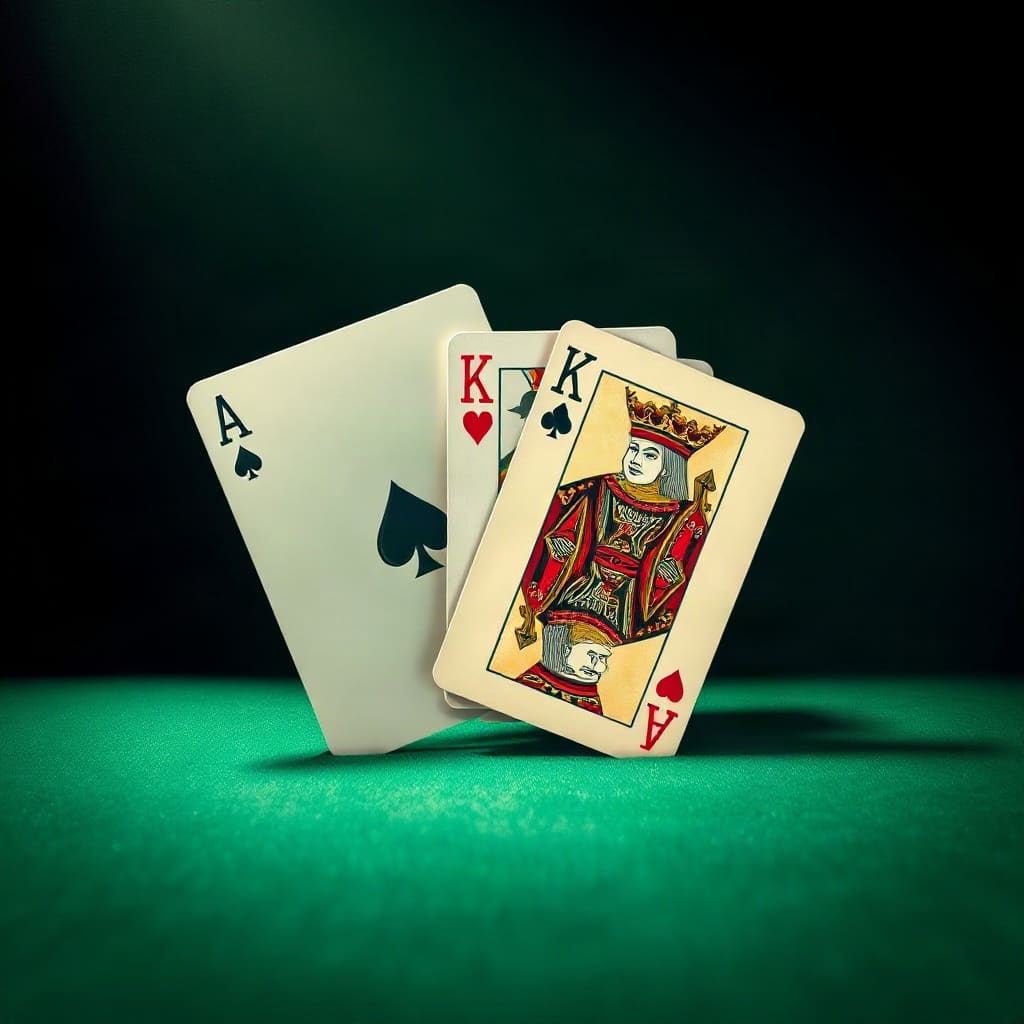
Blackjack
- Provider
- Evolution Gaming
- Game Type
- Table Game
- RTP
- 99.5% (with correct basic strategy)
Overview
Blackjack is a card game where players compete against the dealer’s hand rather than against each other, aiming for a total value as close to 21 as possible without going over. It is widely regarded as one of the most strategy-influenced table games available at online casinos, since the decisions a player makes on each hand have a measurable effect on the game’s house edge. Live-dealer blackjack, streamed from a real table, has kept the traditional pacing and social feel of the game intact for online play.
How It Works
Each player is dealt two cards, as is the dealer (with one dealer card often shown face down until later). Based on the two-card total, players choose to hit (take another card), stand (keep their current total), double down (double the bet for one additional card), or split (if the two cards are a matching pair, split them into two separate hands). The dealer then plays their hand according to fixed rules, usually standing on 17 or higher. Whoever ends with a higher total without exceeding 21 wins; a tie generally results in a push where the bet is returned.
RTP & House Edge
Blackjack has one of the lowest house edges among common table games when played with correct basic strategy, often around 0.5% depending on specific table rules, translating to a theoretical RTP near 99.5%. This figure assumes optimal decision-making at every point in the hand; playing without a strategy typically increases the effective house edge substantially, since incorrect decisions favour the dealer’s fixed rules more often.
Tips for Players
- Learn basic strategy for the specific table rules (number of decks, dealer soft-17 rule) before playing, as this materially affects long-run outcomes.
- Set a budget before sitting down and stick to it regardless of a winning or losing streak.
- Treat side bets as a separate, higher-risk decision rather than an automatic add-on to every hand.
- Avoid increasing bets to chase losses — each hand is an independent event.
- Take breaks between sessions rather than playing for extended continuous periods.
Play Responsibly
Set a budget before playing and treat it as entertainment, not income.
Strengths
- Player decisions (hit, stand, double, split) genuinely influence the house edge
- One of the lowest house edges among common table games when basic strategy is used
- Widely available in live-dealer format with multiple seating and side-bet options
- Well-documented basic strategy charts are publicly available
Worth Noting
- Playing without knowledge of basic strategy significantly raises the effective house edge
- Side bets typically carry a much higher house edge than the main hand
Frequently Asked Questions
What is the goal in Blackjack?
Players aim to have a hand value closer to 21 than the dealer's hand, without exceeding 21 ('busting').
What does 'basic strategy' mean?
Basic strategy is a set of mathematically derived decisions (whether to hit, stand, double down, or split) for every possible combination of player hand and dealer up-card, designed to minimise the house edge over time.
Why do some tables have different house edges?
Specific table rules — such as how many decks are used, whether the dealer stands or hits on a soft 17, and payout ratios for a natural blackjack — all affect the house edge, so it can vary slightly between tables.
Are side bets worth considering?
Side bets, such as Perfect Pairs or 21+3, generally carry a considerably higher house edge than the main blackjack hand and are typically viewed as a higher-risk addition rather than a core part of the game.