
A dementia diagnosis changes everything about how you think about care for your parent.
The needs of a person with dementia are different from those of someone who is simply elderly and frail. Wandering, confusion, aggression, sundowning, incontinence, and the gradual loss of the ability to communicate — these require not just nursing skill but a specific kind of patience, training, and environment. Getting dementia care in Malaysia right depends on understanding which type of care matches the stage your parent is at.
This guide will help you understand what genuine dementia care in Malaysia looks like, how to evaluate facilities that claim to offer it, and what to expect as the condition progresses.
Understanding Dementia Care Needs: What Each Stage Requires
Dementia is not one thing. The care appropriate for someone in the early stages of Alzheimer’s disease — who is still mobile, partially communicative, and occasionally lucid — is very different from the care needed in the late stages, when the person may be non-verbal, bedridden, and requiring full nursing care.
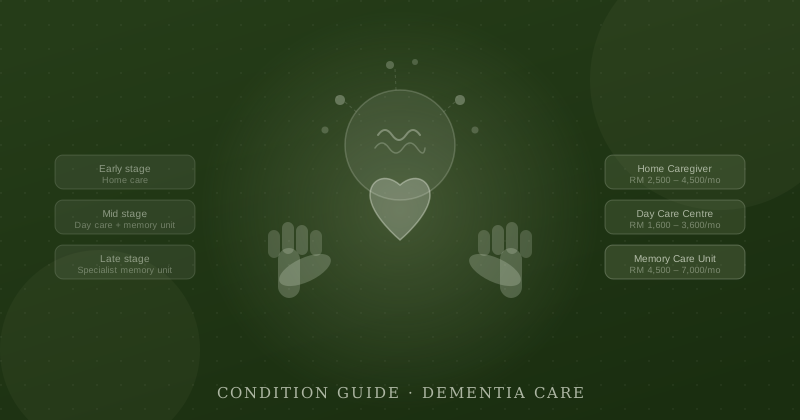
The broad stages, and what they typically require:
Early-to-mid stage dementia:
- The person is usually still mobile, often continent, and can participate in structured activities
- Key needs: routine, safe environment (no wandering hazards), cognitive stimulation, patience
- Home care with a trained caregiver may still be viable at this stage
- A memory care day centre (day care) can provide structured activity while allowing the person to live at home
Mid-to-late stage dementia:
- Wandering risk is high; the person may not recognise familiar people or places
- Incontinence is common; personal hygiene care requires patience and skill
- Resistance to care (aggression, refusal) is possible
- Full residential care in a dedicated memory unit is usually necessary at this stage
Late stage dementia:
- The person is typically bedridden and non-verbal
- Swallowing difficulties may require dietary modification or tube feeding
- Care is primarily palliative and comfort-focused
- High-dependency nursing care is required — see our bedridden patient care guide for clinical procedures involved at this stage
Knowing which stage your parent is at — ideally confirmed by a geriatrician or neurologist — will tell you what type of facility and staffing you need.
The Three Main Care Options in Malaysia
1. Home Care with a Trained Dementia Caregiver
For early-to-mid stage dementia, having a trained caregiver come to your parent’s home — or having a live-in caregiver — can preserve familiarity and routine while providing day-to-day support.
The key word is trained. A general domestic helper without dementia-specific training is not adequate for a parent who wanders, has episodes of aggression, or requires skilled behaviour management. When sourcing a caregiver for dementia, ask specifically about their training and experience with cognitive decline.
Home care agencies in Malaysia that specialise in elder care can typically match you with trained dementia caregivers. Our guide to hiring a caregiver in Malaysia covers how to vet agency and private carers, what to pay, and what a good contract looks like. Rates vary: RM 120–RM 200 per day for a visiting caregiver, RM 2,500–RM 4,500/month for a live-in arrangement.
When home care is no longer safe: If your parent is wandering, particularly at night, or if carer stress in the family is becoming unsustainable, residential care is likely the safer option.
2. Dementia Day Care Centres
Day care centres allow your parent to attend a structured programme during the day and return home in the evening. For families who are still managing care at home, a good day centre provides:
- Cognitive stimulation through activities designed for people with dementia
- Social engagement with peers
- Supervised meals and basic personal care
- Respite for family caregivers during working hours
In the Klang Valley, dementia-specific day care is limited but growing. Ask any day care centre you consider what specific dementia programming they offer — not just whether they accept residents with dementia.
Costs: RM 80–RM 180 per day, including transport in some facilities.
3. Residential Dementia Care (Memory Units)
This is what most families are researching when they come to us: a nursing home or care facility with a dedicated memory care unit or dementia ward.
In Malaysia, the quality of dementia-specific residential care varies enormously. There is a difference between:
- A nursing home that accepts residents with dementia (the majority of homes; they manage dementia as one of many conditions)
- A nursing home with a dedicated memory care unit (purpose-built or adapted spaces, with staff specifically trained for dementia care)
The latter is what you are looking for if your parent is mid-to-late stage.
What Good Dementia Care in Malaysia Looks Like
The Physical Environment
Dementia care environments should be designed to reduce confusion and risk, not maximise efficiency for staff.
Look for:
- Secured perimeter or dementia wing. Wandering is a leading cause of injury and death in people with dementia. A facility without a secured unit is a high-risk environment for a mobile person with dementia.
- Low-stimulation communal spaces. Busy, noisy, over-stimulating environments can trigger agitation. Look for calm, well-lit, clutter-free spaces.
- Clear wayfinding. Simple, high-contrast signage (including pictures, not just text) helps orientation.
- Safe outdoor access. A secure garden or courtyard where residents can move safely is a significant quality indicator.
- No disorienting features. Mirrors can cause distress for people with advanced dementia (they may not recognise their reflection). Good facilities address this.
The Staffing
Ask directly:
- What training do your staff have in dementia care? General nursing qualifications are not sufficient. Look for specific dementia care training or qualifications.
- What is your staff turnover rate? High turnover is particularly harmful for people with dementia, who depend on familiar faces and consistent routines.
- How do you manage agitation or aggression? The answer should describe de-escalation approaches and person-centred care, not chemical restraint as a first resort.
- What is the ratio of trained dementia staff to residents in the memory unit?
The Programme
A person with dementia, even in the later stages, benefits from structured activity. Ask what the daily programme looks like, and what it specifically offers for dementia residents — not just general activities shared with non-dementia residents.
Evidence-based activities for dementia include: reminiscence therapy (using music, photos, and familiar objects from the person’s past), sensory stimulation, music therapy, gentle exercise, and simple task-based engagement (folding, sorting, gardening).
Red Flags in Facilities That Claim Dementia Expertise
These are warning signs to take seriously:
“We accept dementia patients” ≠ dementia-specialist care. Most nursing homes in Malaysia will accept residents with dementia. That does not mean they have the staff training, environment, or programme to care for them well. Push beyond this claim.
Over-reliance on medication for management. If a facility’s answer to behavioural challenges is sedation, ask hard questions. Sedation is appropriate in some situations, but should never be the primary behavioural management tool.
Mixed wards without clear dementia-specific space. A person with mid-stage dementia placed in a general ward with physically frail but cognitively intact residents is in the wrong environment — for everyone involved.
No family communication structure. Dementia care should involve regular communication with family. If a facility is vague about how they keep families informed of behavioural changes, mood shifts, or medical concerns, that is a problem.
Staff who appear untrained in redirection. Spend time in the facility and observe. Do staff respond to confused or distressed residents with patience and calm redirection? Or do they appear irritated or dismissive?
Questions to Ask on Your Visit
- Is there a dedicated dementia or memory care unit, or are dementia residents integrated with general nursing home residents?
- Is the unit secured (to prevent unsupervised exit)?
- What dementia-specific training do staff in this unit hold?
- What is the staff-to-resident ratio in the dementia ward specifically?
- How do you handle a resident who becomes agitated or aggressive?
- What does a typical day look like for a dementia resident?
- How do you communicate with family members about changes in the resident’s condition?
- What happens when a resident’s dementia progresses significantly — can they remain here?
- Do you have a doctor or geriatrician who visits regularly?
- Can we speak to another family whose parent has been here for more than a year?
Planning for Progression
One of the hardest aspects of placing a parent with dementia is that their needs will change. A facility that is appropriate today may not be appropriate in 18 months.
When you select a facility, ask explicitly: what happens when my parent’s dementia progresses? A good facility will explain their capability across care levels, including late-stage palliative care. A facility that can only say “we’ll reassess at the time” is giving you an incomplete answer.
If a facility’s model requires you to move your parent when their condition advances, factor that into your decision — a move at late-stage dementia is distressing for the resident and the family.
Costs for Dementia Care in Malaysia
Dementia-specialist care commands a premium over standard nursing home care, reflecting the additional staffing, training, and environment required.
| Care option | Approximate monthly cost |
|---|---|
| Visiting dementia caregiver (home) | RM 3,600 – RM 6,000 |
| Live-in trained caregiver | RM 2,500 – RM 4,500 |
| Day care (5 days/week) | RM 1,600 – RM 3,600 |
| Nursing home (dementia-capable, shared room) | RM 3,500 – RM 5,500 |
| Nursing home (dedicated memory unit) | RM 4,500 – RM 7,000 |
These are 2026 estimates based on our facility research. Premium Klang Valley facilities with specialist dementia units sit at the higher end; facilities in Ipoh, Melaka, and Johor Bahru are typically lower.
Getting Support for Yourself
If you are the primary caregiver for a parent with dementia — whether they are at home or in a facility — please do not overlook your own wellbeing. Dementia caregiving is among the most demanding caring roles that exists.
Alzheimer’s Disease Foundation Malaysia (ADFM) offers support groups, helplines, and caregiver resources. Their helpline is a good first call if you are feeling overwhelmed or uncertain.
Choosing a care facility does not end your role — it changes it. You move from being the day-to-day caregiver to being the advocate, the connector, and the constant presence in your parent’s life who helps the care team understand who your parent was before the illness. That role matters.
Frequently Asked Questions — Dementia Care in Malaysia
How much does dementia care cost in Malaysia?
Dementia care in Malaysia costs RM 2,500–RM 7,000 per month depending on the care setting. A trained live-in caregiver costs RM 2,500–RM 4,500/month. Dementia-capable nursing homes with shared rooms charge RM 3,500–RM 5,500. Dedicated memory care units — the gold standard for dementia care in Malaysia — run RM 4,500–RM 7,000. Day care centres (5 days/week) cost RM 1,600–RM 3,600/month. These are 2026 estimates; Klang Valley facilities sit at the higher end, while Ipoh, Melaka, and Johor Bahru are typically lower.
What is the difference between a dementia care unit and a general nursing home in Malaysia?
Most nursing homes in Malaysia accept residents with dementia, but manage it alongside other conditions — without purpose-built spaces or specialist staffing. A dedicated memory care unit has secured perimeters to prevent wandering, staff with specific dementia training qualifications, a structured daily programme (reminiscence therapy, music therapy, sensory stimulation), and an environment designed to reduce confusion and distress. For mid-to-late stage dementia, a dedicated unit is strongly preferred over a general nursing home.
At what stage of dementia does residential care become necessary?
For most families in Malaysia, residential dementia care becomes necessary at the mid-to-late stage — when the person wanders (especially at night), no longer recognises familiar faces or places, or when the family caregiver’s stress becomes unsustainable. Early-to-mid stage dementia can often be managed with a trained home caregiver or dementia day centre. A geriatrician or neurologist can help you assess which stage your parent is at.
How do I find a genuine dementia care specialist facility in Malaysia?
Look for facilities with a dedicated memory care unit — not just those that claim to “accept dementia patients.” When visiting, ask: Is the unit physically secured? What dementia-specific training do staff hold? What is the staff-to-resident ratio in the dementia ward? What does a structured daily programme for dementia residents look like? The Alzheimer’s Disease Foundation Malaysia (ADFM) also maintains a helpline and can provide referrals.
Is home care suitable for a parent with dementia in Malaysia?
Yes, for early-to-mid stage dementia — provided the caregiver has specific dementia training. A trained dementia caregiver can manage wandering risks, behaviour changes, and personal care while preserving your parent’s familiar environment. Home care agencies in Malaysia that specialise in elderly care can match you with trained dementia caregivers. Rates run RM 120–RM 200/day for visiting care, or RM 2,500–RM 4,500/month for live-in. When home care is no longer safe — particularly if wandering at night — residential care is the appropriate next step.
Looking for dementia-capable facilities? Filter our listings by care type: browse dementia care providers or explore homes in Kuala Lumpur and Petaling Jaya.