
Last checked: 5 November 2026. JKM updates its rules from time to time, so confirm details with your district office before you go.
The Department of Social Welfare (Jabatan Kebajikan Masyarakat, JKM) is the main government agency that gives monthly aid to older Malaysians and their carers. Applying is not complicated, but families often lose time by going to the office without the right documents, or by registering online and missing the follow-up visit.
This guide walks through which JKM aid applies to senior citizens and how to apply, step by step. For a wider look at all government aid for seniors, including STR, SARA and state schemes, see our guide to bantuan warga emas.
Which JKM aid can older people get?
| JKM aid | Amount | Who it’s for |
|---|---|---|
| Bantuan Warga Emas (BWE) | RM600 a month | Citizens 60+ in hardcore poor households |
| Bantuan Penjagaan (BPT) | RM500 a month (RM600 announced in Budget 2027) | The carer of a bedridden or chronically ill person, household income up to RM5,000 |
| Bantuan OKU Tidak Berupaya Bekerja (BTB) | RM300 a month | People with disabilities aged 16 to 59 who can’t work. New applicants aged 60+ should apply for BWE instead |
| Bantuan Am Persekutuan (BA) | RM150 to RM500 a month per family | Low-income families in the Federal Territories only |
| Rumah Seri Kenangan | Free place in a government home | Seniors 60+ with no home, income or family. A last resort, subject to vacancies |
| Pusat Aktiviti Warga Emas (PAWE) | Free activities | Anyone aged 60+ |
Most families caring for an older parent will be looking at BWE, BPT or both.
Before you apply: check eligibility
For Bantuan Warga Emas (BWE)
- Malaysian citizen living in Malaysia
- Aged 60 or over
- Household income at or below the hardcore poverty line (PGK)
- Not living in a JKM institution, or in a centre that gives free care with a JKM food grant
A senior with no children can still qualify while living with relatives or a carer who earns more.
For Bantuan Penjagaan (BPT)
- The patient is bedridden, or has a chronic illness and needs care
- Household income of RM5,000 or less
- A doctor’s confirmation letter, valid for up to two years
JKM checks every application with a means test, which usually includes an investigation by a welfare officer.
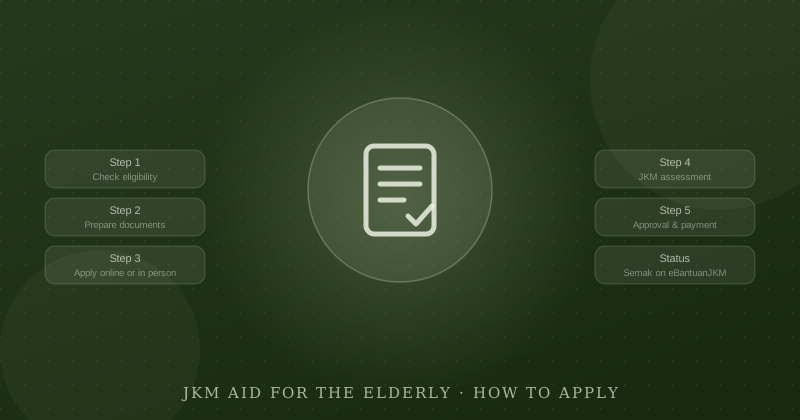
Step 1: Gather your documents
Bring originals and photocopies of:
- The applicant’s MyKad
- MyKad or MyKid of everyone living in the household
- Proof of income for the household, one of:
- A letter from the employer
- An income confirmation form (Borang Pengesahan Pendapatan) certified by the penghulu, ketua kampung or another community leader
- A statutory declaration made before a Commissioner for Oaths, if self-employed
- One recent utility bill (electricity or water)
- Latest bank statement or bank account confirmation slip in the applicant’s name
- For BPT: the doctor’s confirmation letter
Missing income proof is one of the most common reasons for a wasted trip. Get the penghulu’s certification done first if no one in the household has a payslip.
Step 2: Choose how to apply
Option A: at the district JKM office (all states)
Go to the Pejabat Kebajikan Masyarakat Daerah (PKMD) for the district where your parent lives. Ask for form JKM18 (the aid application form), fill it in, and hand it in with your documents. The form can also be downloaded from the eBantuanJKM portal and filled in beforehand.
If your parent can’t travel, ask the office whether a family member can submit on their behalf.
Option B: online through eBantuanJKM (five states only)
Online registration on the eBantuanJKM portal (ebantuanjkm.jkm.gov.my) is open only in:
- Perlis
- Kedah
- Selangor
- WP Kuala Lumpur
- WP Labuan
Important: registering online is only the first step. You must take your documents to the district JKM office within 14 days of registering. If you don’t, the system cancels the application automatically.
Step 3: The JKM investigation
After you apply, a welfare officer assesses the household’s situation and income. This often includes a visit or interview. Be ready to explain:
- Who lives in the home and what each person earns
- Your parent’s health and care needs
- Any other help the family already receives
Answer honestly and keep copies of everything you submit.
Step 4: Approval and payment
If the application is approved, aid is paid monthly into the bank account you provided. JKM has said in Parliament that it aims to complete monthly payments by the 10th of each month.
JKM doesn’t publish a standard processing time. If you haven’t heard back after a few weeks, contact the district office.
Ongoing aid is reviewed from time to time using a review form (JKM20, Borang Kajian Semula). Tell JKM if your parent’s circumstances change, for example if household income goes up or they move into a care home.
Step 5: Check your application status
- Go to ebantuanjkm.jkm.gov.my.
- Choose Semakan Status Permohonan (application status check).
- Enter the applicant’s IC number.
The list shows aid that has been applied for or is currently being received. If you’re not sure what a status means, or if an application seems stuck, contact the district JKM office that handled it.
If your application is rejected
Ask the district office for the reason. Common reasons include household income above the limit, assets that produce income, or missing documents. If your situation changes, for example a family member loses their job or your parent’s health gets worse, you can apply again with updated documents.
Contacting JKM
- Talian Kasih: 15999, or WhatsApp 019-261 5999. Open 24 hours.
- District JKM office: the best contact for anything about a specific application.
- JKM headquarters: complaints by email to [email protected].
When JKM aid isn’t enough
JKM aid helps with daily costs but rarely covers full-time care. If your parent needs more support:
- Day care centres and home care can help while your parent lives at home.
- Our guide to nursing home costs in Malaysia explains what full-time care costs, and our nursing home directory lets you compare homes by state and city.
- Our guide to bantuan warga emas covers other aid your family may qualify for, including STR, SARA, healthcare discounts and state schemes.