Most families first notice something small. Your mother asks the same question twice in ten minutes. Your father, who has driven the same route for thirty years, gets lost on the way home. It is easy to put it down to age, and often that is all it is. Sometimes it is the start of dementia.
This guide explains what dementia means, the early signs to look out for, what causes it, and how to get a proper diagnosis in Malaysia. If your parent has already been diagnosed and you are looking at care options, see our guide to dementia care in Malaysia.
What dementia means
Dementia is not one disease. It is the name for a group of symptoms that happen when the brain is damaged by disease. The World Health Organization describes it as a condition that affects memory, thinking and the ability to carry out everyday activities, and that gets worse over time.
In Bahasa Malaysia it is called demensia. Many families still use the word nyanyuk. The problem with that word is that it treats confusion in old age as normal. It is not. Dementia is more common after 65, but it is caused by disease, and many people live into their 90s with sharp minds.
A useful way to think about it: dementia is the umbrella, and conditions like Alzheimer’s disease sit underneath it. Saying someone has dementia is like saying they have heart disease. It tells you what is happening, not exactly why.
How common dementia is
According to the WHO, around 57 million people worldwide were living with dementia in 2021, and there are nearly 10 million new cases every year. It is now one of the leading causes of death and disability among older people.
In Malaysia:
- The National Health and Morbidity Survey (NHMS) 2018 found probable dementia in about 9% of people aged 60 and over. The rate rises sharply with age: about 5% of people in their 60s, 12% in their 70s and 33% of those aged 80 and over. These figures come from a screening test, not a full clinical diagnosis, but they give a sense of scale.
- The Alzheimer’s Disease Foundation Malaysia (ADFM) estimates that 204,000 to 264,000 Malaysians were living with dementia in 2020, and that this could reach 637,500 to 825,000 by 2050.
Many cases are never diagnosed. Families often assume the changes are just old age, and specialist memory clinics are mostly in the larger cities.
Early signs of dementia
Dementia usually starts slowly. These are the early signs doctors and dementia charities most often list:
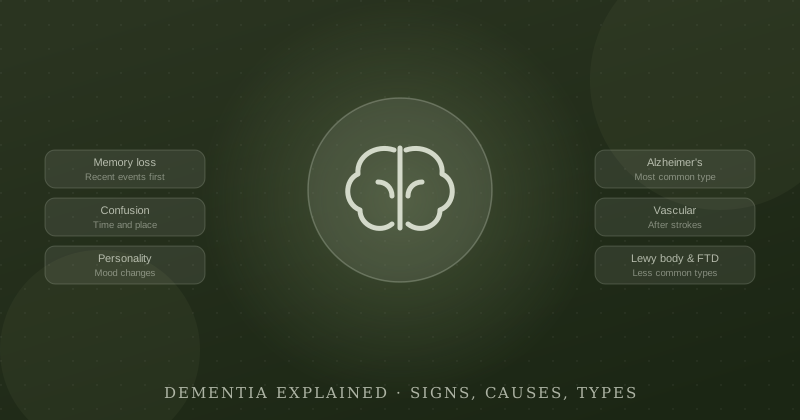
- Forgetting recent events. Your parent remembers their wedding day clearly but cannot recall what they ate for lunch or a conversation from this morning.
- Losing things and not being able to retrace steps. Everyone misplaces their keys. Putting them in the fridge and having no idea how they got there is different.
- Getting lost in familiar places. Losing the way home from the mosque, the pasar or a relative’s house.
- Losing track of time. Not knowing the day, month or year, or confusing night and day.
- Trouble finding words. Stopping mid-sentence, calling things by the wrong name, or struggling to follow a conversation.
- Difficulty with familiar tasks. A parent who always cooked suddenly burns food or forgets steps in a favourite recipe. Bills go unpaid.
- Poor judgement. Giving large sums to strangers or telemarketers, or dressing for the wrong weather.
- Misjudging distances or space. Trouble with stairs, parking, or reaching for a cup.
- Withdrawing from people and hobbies. Skipping prayers at the surau, church or temple, or avoiding gatherings they used to enjoy.
- Changes in mood or personality. New suspicion, anxiety, irritability or low mood. These can appear before memory problems.
Normal ageing or dementia?
| Normal with age | May be a sign of dementia |
|---|---|
| Forgetting a name, then remembering it later | Forgetting recent events and not recalling them at all |
| Misplacing glasses now and then | Putting things in odd places and accusing others of taking them |
| Occasionally missing a monthly payment | Being unable to manage money or bills at all |
| Needing help with a new phone app | Struggling with tasks done for years, like cooking a favourite dish |
| Searching for the right word sometimes | Frequently losing the thread of a conversation |
| Feeling weary of some social duties | Withdrawing from friends, prayers and hobbies |
One sign on its own is rarely a reason to panic. A pattern of several, getting worse over months, is a reason to see a doctor.
Symptoms as dementia progresses
Dementia changes over time, and so do the symptoms:
- Early stage: mild forgetfulness, losing track of time, repeating questions, needing reminders. Most people can still live fairly independently.
- Middle stage: forgetting names of family members, getting lost at home, needing help with bathing, dressing and toileting, confusion in the late afternoon (often called sundowning), wandering, sleep problems, and changes in behaviour.
- Late stage: losing the ability to speak or walk, difficulty swallowing, not recognising close family, and needing help with everything, around the clock.
How fast this happens varies a great deal. Some people stay in the early stage for years.
What causes dementia: the main types
Different diseases damage the brain in different ways. The main types are:
- Alzheimer’s disease. The most common cause, behind roughly 60 to 70% of cases. Abnormal proteins build up in the brain and damage nerve cells. Memory problems usually come first. Read more in our guide to Alzheimer’s disease.
- Vascular dementia. Caused by reduced blood flow to the brain, often after a stroke or a series of small strokes. Symptoms can appear suddenly and get worse in steps. High blood pressure, diabetes and smoking all raise the risk.
- Lewy body dementia. Caused by protein deposits called Lewy bodies. It often brings vivid visual hallucinations, big swings in alertness, and movement problems similar to Parkinson’s disease.
- Frontotemporal dementia. Affects the front and sides of the brain. It tends to start younger, often in the 50s or 60s, and changes personality, behaviour or language before memory.
- Mixed dementia. Many older people have more than one type, most often Alzheimer’s and vascular dementia together.
Other conditions can cause symptoms that look like dementia but can be treated, including thyroid problems, vitamin B12 deficiency, depression, medication side effects and infections. This is one of the main reasons to get a proper assessment rather than assuming.
Risk factors, and what you can change
Age is the strongest risk factor. Family history matters too, although most dementia is not directly inherited.
The good news is that a lot of risk is within our control. The 2024 Lancet Commission on dementia found that about 45% of dementia cases could potentially be prevented or delayed by tackling 14 risk factors across a person’s life:
- Less education in early life
- Hearing loss
- High blood pressure
- Smoking
- Obesity
- Depression
- Physical inactivity
- Diabetes
- Heavy drinking
- Head injury
- Air pollution
- Social isolation
- High LDL (“bad”) cholesterol in midlife
- Untreated vision loss in later life
Several of these are very common in Malaysia, particularly diabetes, high blood pressure and inactivity. Managing them helps the heart and the brain at the same time. Hearing aids, cataract surgery and staying socially active are simple steps that are often overlooked.
How dementia is diagnosed in Malaysia
There is no single test for dementia. Diagnosis usually involves:
- A detailed history, ideally with a family member who knows the person well
- Memory and thinking tests, such as short questionnaires and tasks
- A physical examination and blood tests to rule out treatable causes
- A brain scan (CT or MRI) in many cases
Where to start:
- Your GP or klinik kesihatan. Explain what you have noticed, with examples. Bring a list of medicines your parent takes. The doctor can rule out simple causes and refer you on.
- A memory clinic or specialist. Dementia is assessed by geriatricians (elderly-care doctors), psychiatrists who specialise in older people, and neurologists. Many larger government hospitals and university hospitals run memory or geriatric clinics, usually by referral. Diagnosis often takes a few visits.
- Private hospitals. Some private hospitals have memory clinics that accept patients without a referral. This is faster but costs more.
Go with your parent if you can. People with early dementia often cover their difficulties well in a short appointment, and the doctor needs to hear what you see at home.
Is there a cure?
There is no cure for most types of dementia. That does not mean nothing can be done:
- Medicines can ease memory and thinking symptoms for a time in Alzheimer’s and some other types.
- A new drug, lecanemab, was approved in Malaysia in 2026 for early Alzheimer’s disease. It can slow decline in carefully selected patients. See our Alzheimer’s guide for details.
- Treating other conditions such as blood pressure, diabetes, hearing loss and depression can protect remaining brain function.
- Routine, activity and good care make a large difference to quality of life, for the person and the family.
What to do next
- Write down what you have noticed, with dates and examples. It helps the doctor and helps you see the pattern.
- Book a GP appointment and ask about a referral to a memory clinic.
- Talk to the Alzheimer’s Disease Foundation Malaysia (ADFM). Its helpline is 03-7931 5850. ADFM runs support groups, caregiver training and a day care centre in Petaling Jaya.
- Plan ahead while your parent can still take part. Talk about wishes, finances and future care early, when decisions can be made together.
- Look at support options. Day care centres and home care can help in the earlier stages. When more support is needed, our dementia care directory lists providers across Malaysia, and our guide on how to choose a nursing home covers the questions to ask.
Dementia is hard on families. Getting a clear diagnosis early gives you time to plan, find support and make the most of the good years.