
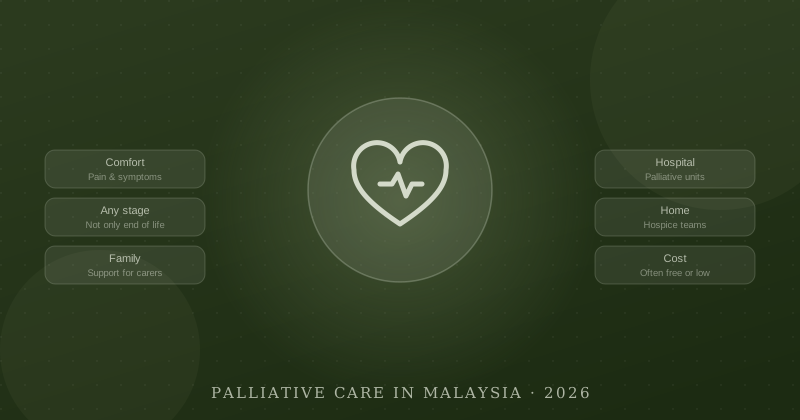
When a parent has a serious illness that can’t be cured, the questions change. Families stop asking only “how do we treat this?” and start asking “how do we keep them comfortable?” and “how do we cope?”. Palliative care exists to answer those questions.
Yet many Malaysian families never hear about it, or only hear about it in the last few days. The Ministry of Health’s own national policy estimates that less than 10% of Malaysians who need palliative care receive it.
This guide explains what palliative care is, who it is for, and how to get it in Malaysia, often for free.
What palliative care means
The World Health Organization describes palliative care as care that improves the quality of life of patients and their families facing a life-threatening illness. It does this by preventing and relieving suffering, whether physical, emotional, social or spiritual.
In practice, a palliative care team helps with:
- Pain, including the right medicines at the right doses
- Other symptoms such as breathlessness, nausea, constipation, poor appetite, tiredness, anxiety and confusion
- Difficult decisions about treatment, hospital admissions and the future
- Emotional and spiritual support for the patient
- Practical and emotional support for the family, including after the person dies
The aim is to help someone live as well as possible for the time they have, without trying to lengthen or shorten that time.
In Bahasa Malaysia, palliative care is called rawatan paliatif or penjagaan paliatif.
Palliative care vs hospice vs end-of-life care
These terms overlap and are often confused.
| Term | What it means |
|---|---|
| Palliative care | Comfort-focused care for anyone with a serious illness. It can start at diagnosis and run alongside treatments like chemotherapy, dialysis or heart medicines. |
| Hospice care | Palliative care for people nearing the end of life, when treatment aimed at a cure has stopped and the focus is fully on comfort. In Malaysia, many charities named “hospis” or “hospice” provide palliative care at home. |
| End-of-life care | Care in the last weeks or days of life, including for the family. |
A common misunderstanding is that accepting palliative care means “giving up”. It doesn’t. Many people receive palliative support for months or years while still having active treatment.
Who palliative care is for
Palliative care is not only for cancer. According to the WHO, adults who need it most often have:
- Heart disease, including heart failure
- Cancer
- Chronic lung disease such as COPD
- Kidney failure
- Diabetes complications
- Neurological conditions such as stroke, Parkinson’s disease and motor neurone disease
- Advanced dementia, including late-stage Alzheimer’s disease
For older Malaysians, it is worth asking about palliative care if your parent:
- Has been admitted to hospital several times in recent months
- Is losing weight and spending more of the day in bed
- Has symptoms such as pain or breathlessness that are hard to control
- Has an illness the doctors say cannot be cured
- Has said they don’t want more aggressive treatment
Palliative care in Malaysia: the big picture
Malaysia has a National Palliative Care Policy and Strategic Plan 2019–2030 from the Ministry of Health. It estimated that:
- About 100,000 people needed palliative care in 2014, around 70% of all deaths
- This is expected to rise to about 240,000 people a year by 2030 as the population ages
- Less than 10% of the need was being met
Care is provided by three main groups:
- Government hospitals. A number of Ministry of Health hospitals have palliative care specialists, palliative teams and palliative wards (wad paliatif). Other hospitals can refer patients to them.
- NGO hospices. Around 30 charities across Malaysia provide palliative care, mostly through home visits, and usually free of charge.
- Private hospitals and nursing homes. Some private hospitals have palliative teams, and some nursing homes offer palliative or end-of-life care.
Where to get palliative care
Government hospitals
If your parent is under a government hospital, ask the treating doctor to refer them to the palliative care team. Larger hospitals have specialist teams; smaller ones can refer on. Care in government hospitals is heavily subsidised.
Free hospice care at home
Many families prefer for their parent to be cared for, and to die, at home. NGO hospices make this possible by visiting regularly, managing symptoms and supporting the family.
Hospis Malaysia is a long-running home hospice charity in the Klang Valley:
- Provides palliative care at home, free of charge, funded by donations
- Home visits, emergency visits after hours and telephone support
- Cares for around 1,500 patients a year
- Tel: 03-9133 3936 (Monday to Friday, 8am to 5pm)
- Referrals through the online form on hospismalaysia.org
Other hospice and palliative care charities operate in other states, including in Penang, Perak, Johor, Klang, Sarawak and Sabah. Coverage areas and services differ, so call ahead to check that they serve your area and what they provide.
Private hospitals
Private hospitals offer palliative consultations and inpatient care. This is faster to access but can be costly, so ask for a written estimate and check what your insurance covers.
Nursing homes with palliative care
For people who need round-the-clock care that the family can’t provide at home, some nursing homes offer palliative and end-of-life care. Ask:
- Do you have nurses on duty 24 hours?
- Is there a doctor who visits, and how quickly can they come?
- Can you give pain relief, including stronger medicines, when needed?
- Do you work with a hospice or hospital palliative team?
- Can the family stay with the resident at the end?
- How do you support religious practices and last rites?
If your family is Muslim, our Muslim-friendly care page lists homes that keep prayers and serve halal food. Some offer palliative care.
How much does palliative care cost in Malaysia?
- NGO hospices: usually free. Hospis Malaysia, for example, does not charge patients. Each home visit costs the charity around RM500, paid for by donations.
- Government hospitals: heavily subsidised, as with other government hospital care.
- Private hospitals: costs vary widely and can be high for longer stays. Get an estimate first.
- Nursing homes: palliative care is usually part of the monthly fee for higher-dependency residents. See our guide to nursing home costs in Malaysia for typical ranges.
Equipment such as hospital beds, oxygen concentrators and wheelchairs can sometimes be borrowed from hospices or community groups instead of bought.
How to get started
- Talk to your parent’s doctor. Ask directly: “Would palliative care help?” and “Can you refer us to the palliative team?”
- Contact a hospice near you, even before you think you need it. Many accept referrals from families as well as doctors.
- Talk with your parent about their wishes, if they are able: where they would like to be cared for, what treatments they would or wouldn’t want, and who should make decisions if they can’t.
- Look after yourself. Caring for a seriously ill parent is exhausting. Palliative teams support families too, and respite and day care can give you a break.
Palliative care is about comfort, dignity and time well spent. The earlier it starts, the more it can help.